Most specialists believe that energy security is a guarantee of access to natural resources, a certain degree of control over energy routes and their alternatives. In short, the notion of energy security is defined as “safe resources at a reasonable price” (Daniel Yergin, ‘Ensuring Energy Security’ [2006] Foreign Affairs https://www.foreignaffairs.com/articles/2006-03-01/ensuring-energy-security).This is the most comprehensive definition known so far. Actually, the notion has a much wider meaning than that in which it ordinarily appears as part of the energy triangle. Therefore, we can talk about energy security only in the presence of sufficient and available energy resources. It is obvious that a greater interruption of energy supply has a major negative impact on the stability and prosperity of a state, but also on the economic growth.However, the term of energy security is closely linked to the identification of supply routes and alternatives and the security of resources.
In any case, the current political and economic realities have demonstrated that the great consumers have to move from the utopia of energy independence to energy interdependence.
Therefore, most scholars have tried to provide a more comprehensive definition of energy security in order to enclose the essential aspects of this notion. However, states interpret this term differently according to the particular interests that arise for each actor in the energy market. For Russia, it is very important to maintain its control over the main pipelines used to supplies the international market with its hydrocarbons, for instance. In other words, the energy-exporting countries focus on the security of demand. Developing countries have another vision of energy security being particularly interested in price fluctuations because this indicator might affect their balance of payments.Furthermore, for the US, the energy security goal is towards the total energy independence, especially from the Gulf countries.In Europe, most of the important debates are on the question of dependence on imported natural gas from Russia.In addition, building new nuclear power plants is an important point in European energy policy as well.
Energy security is not only threatened by terrorism, political upheaval, armed conflicts, piracy, but is also vulnerable to hurricanes, floods, earthquakes, or human hand damage. For example, an explosion on a Chinese oil field will cause for the Chinese government to buy more oil, which will lead to an increase in the international price of oil and, implicitly, gasoline in the US. As US Senator Dick Lugar (‘Energy Security Is National Security’ (2011) https://www.foreign.senate.gov/press/…/lugar-welcomes-energy-diplomacy-focus) claimed ,energy security is being jeopardised by six major challenges of the 21st century: interrupt on supply flows; the finite nature of energy resources; using energy as a pressure tool; use of energy revenues for supporting undemocratic regimes; global climate change; high energy costs for developing countries.
Therefore, when it comes about energy security must be taken into account and the challenges posed by the globalisation process, any malfunction or vulnerability in a part of the world in terms of energy source affecting consumers all around the world.Under these circumstances energy security is no longer just an objective of economic policy and has become a constant concern for the international community.
Energy is of a vital importance in our lives and is probably one of the most important players of economic growth. Until 1970, energy was cheap and easy to obtain .After the oil crisis in 1973, this situation has gradually changed and most countries have begun facing energy problems. Energy security has become the main issue of foreign policy all over the world. Nowadays there are no easy-to-exploit oilfields. Therefore, very deep waters and unconventional geographies are the new frontiers for oil and gas companies. At the same time, the costs for switching to other resources are very high.
The South-East of Europe and Black Sea area is a very important zone because it is located geographically close to over two-thirds of the world’s oil and gas resources, especially those in the Middle East and Caspian Sea. This transit area forms a natural energy bridge between source countries and consumer markets taking into account that the European Union is the second world gas market.
Energy security, together with food security, financial security and trade security is part of a wider concept of national and individual security issues, namely economic security. However, achieving a certain level of security depends on the state’s ability to deal with the internal resources and to gain or maintain access to external economic resources.
The notion of energy security depends to a great extent on the regional and global context and on the position occupied in the economic circuit. Hence, consumers and energy-intensive industries ask for reasonable prices and feel fear for the interruptions in supply. Large oil producing countries consider security of demand and incomes from the exports as an essential part of any discussion regarding the term of energy security. On the other hand, oil and gas companies claim that access to new reserves, the ability to develop new infrastructure and stable investment regimes are critical elements in assuring energy security.However, for the European Union, the issue of energy security and particularly gas security represents a key point in any important energy debate. Actually, the EU which is formed of 28 member states is the largest world energy consumer ,all of these states being dependent to a certain extent on hydrocarbons imports, especially from the Russian Federation (At the end of 2006, the EU ranks second, after the US, with an oil consumption of around 14,995 million barrels per day and third, after the US and the Russian Federation, with a natural gas consumption of 18,869 billion m3 /year.(US Energy Information Administration, 2014).However, the data for 2012 presented that within the EU, the oil was the energy source with the largest quantity of imports having the highest import dependence share with about 90%. Natural gas ranks second with 66% on import dependence, followed by coal with 62%.In this line, it has been estimated the dependence on energy imports will increase from 50% at present to 65% in 2030 (European Commission 2014)).
Although the EU policy militates against dependence on Russian gas, we are witness to a paradoxical phenomenon. Thus, in 2017, Gazprom announced a significant increase in gas exports to Europe, according to Financial Times. (Russia’s gas exports to Europe rose 8.1 per cent last year to a record level of 193.9bn cubic metres (bcm), despite rising competition and concerns about the country’s dominances of supply
(Henry Foy, ‘Russia’S Gas Exports To Europe Rise To Record High’ Financial Times 2018 https://www.ft.com/content))
It is worth mentioning that Europe have faced serious issues in gas supply due to the conflict between Russia and Ukraine. As I have already pointed out, Europe’s supply is made by a pipeline’s network transiting Ukraine so that any disruption to Ukraine’s gas supply implicitly affects the rest of the European countries. Moreover, Russia has a slippery policy when it comes to its natural gas and uses very often the energy as a currency in diplomatic relations, and, as a result, prices are quasi non-unified, at the discretion of Gazprom.
Considering all these challenges, European importing countries have turned their attention towards other viable alternative solutions.In this regard, a very often analyzed solution has been around gas supply from the Caspian Sea area, given the political situation created by gaining the independence of Caspian countries from the former Soviet Union.
This is the general context in which two essential alternative solutions intervene: the first is referred to discovery of important offshore gas reserves in the Black Sea around 2012 most of them within the Romanian boundaries .
Tab. 1.1 : Dependence on Russian gas ( Source: IEA)
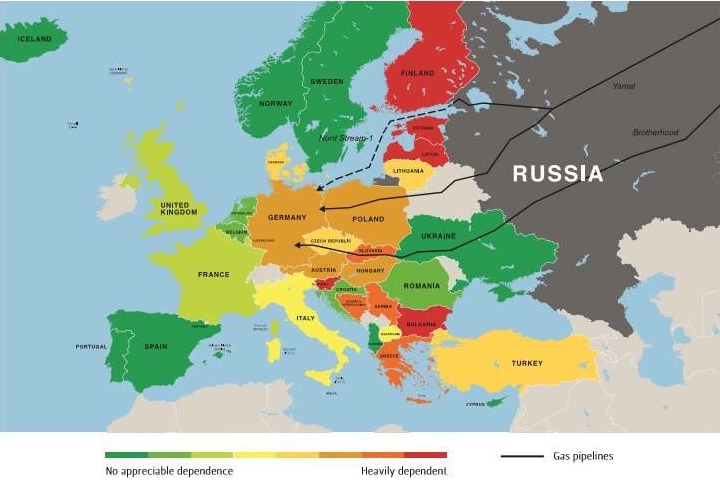
The second aspect is related to a new potential gas supply for Europe from the Caspian Sea region, by building a pipelines-corridor passing through Bulgaria, Romania, Hungary and Austria and further supplying mainly Central and Eastern Europe, as well as Western European countries through gas interconnections .
The linkage between the construction of this energy corridor and future gas exploration in the Black Sea is extremely close.The explanation is very simple: the pipeline will pass almost 200 miles from the Black Sea shore. Considering that through the Romanian pipeline network the connection is possible, that is why it is so important to analyze BRUA .Moreover, both projects are designed to transport non-Russian gas to Europe. In addition, it is superfluous to point out that in the absence of any current possibilities, the Black Sea gas can have no impact. The positive impact of these discoveries will only be given in the presence of the possibility of capitalising these natural resources by using them. In the same way, the gas pipeline has no current utility as it is not connected to any gas source.